Newsletter Subscribe
Enter your email address below and subscribe to our newsletter
Enter your email address below and subscribe to our newsletter

 ByJohn A
The global automotive landscape is experiencing a massive shift. Internal combustion engines, which powered the transport sector for more than a century, are rapidly losing ground to electric powertrains. This shift is not just happening on factory floors or in consumer showrooms; it is completely transforming university lecture halls and engineering laboratories.
For decades, mechanical engineering programs focused on thermodynamics, fluid mechanics, and the intricate machinery of pistons and crankshafts. Today, the rise of Electric Vehicles (EVs) demands a totally different academic approach. Modern automotive development sits at the intersection of chemical engineering, advanced electronics, software development, and systems automation.
As universities scramble to update their degrees, students find themselves facing unprecedented challenges. Navigating an EV engineering curriculum requires mastering multiple disciplines at once. Understanding how these academic programs are structured, where the core difficulties lie, and how to successfully manage the rigorous workload is essential for anyone aiming to shape the future of clean transportation.
Historically, studying automotive engineering meant tracking a relatively predictable path. A student would master core mechanical concepts, learn about structural materials, and perhaps take a few elective courses on vehicle dynamics. The electrical components of a traditional car were largely auxiliary, limited to lighting, starter motors, and basic dashboard entertainment units.
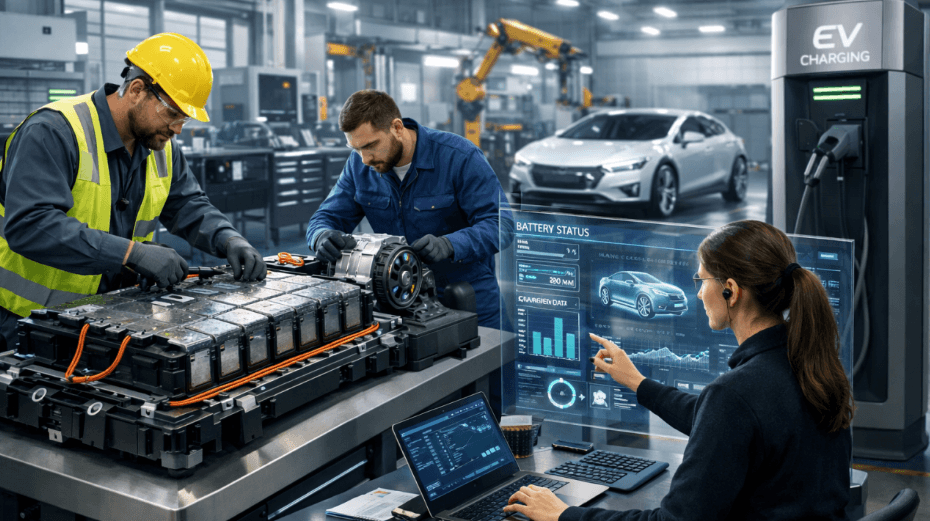
The modern electric vehicle turns that entire framework upside down. An EV is essentially a high-performance computer on wheels, powered by a massive, high-voltage energy storage system. Because of this, universities cannot simply add one or two elective classes about electric cars and call it a day. Instead, they are completely overhauling their engineering departments to merge fields that used to operate in isolation.
Students now need a solid foundation in chemical engineering to understand how lithium-ion cells store and release energy. They must think like electrical engineers to design efficient power inverters and distribution grids within the chassis. At the same time, they must write complex code to manage the electronic brains of the vehicle, all while maintaining the traditional mechanical skills required to design a safe, aerodynamic, and structurally sound frame. This cross-disciplinary reality makes the learning curve incredibly steep.
To appreciate the immense pressure academic programs place on students, it helps to examine the core subjects that form the backbone of an EV engineering specialization. These are not introductory courses; they are highly advanced modules that combine abstract mathematical theories with intense, hands-on laboratory application.
The battery pack is the heart, soul, and most expensive component of any electric vehicle. Students must dive deep into electrochemistry to analyze how different cell chemistries impact energy density, lifecycle, and safety.
Courses cover the mechanics of lithium-ion technology, solid-state batteries, and alternative chemical compositions. Students spend hours modeling how cells degrade over time under various charging habits and environmental conditions.
Batteries and power electronics generate a massive amount of heat during rapid acceleration and fast charging. Managing this thermal energy is critical to prevent catastrophic failures, such as thermal runaway.
Engineering students use complex computational fluid dynamics (CFD) software to design liquid cooling loops, thermal interface materials, and heat exchangers. The math behind heat transfer at high voltages is notoriously unforgiving, requiring absolute precision.
An EV cannot run directly on the direct current (DC) stored in a battery. It requires an advanced inverter to convert that energy into alternating current (AC) for the electric motor.
Students learn to design and analyze these power electronic components, focusing on semiconductor materials like Silicon Carbide (SiC) and Gallium Nitride (GaN). This requires a deep comprehension of electromagnetic interference, signal processing, and high-voltage safety protocols.
The BMS is the digital guardian of the electric vehicle. It monitors the voltage, current, and temperature of thousands of individual cells in real time.
Students in this track focus heavily on embedded software engineering. They write algorithms that calculate the state of charge (SoC) and state of health (SoH), balance individual cells during charging, and trigger emergency disconnects if a fault occurs.
See also: Essential Fashion Pieces Everyone Should Own
Because EV engineering is changing so fast, the academic environment is uniquely stressful. Unlike traditional mechanical engineering, where textbooks have been refined over fifty years, EV curriculum guidelines are often written on the fly as new technologies emerge from corporate research labs.
The first major hurdle is the sheer volume of mathematics and software simulations. A single assignment might require a student to model a thermal cooling plate in MATLAB, simulate a power inverter circuit in Simulink, and write a Python script to optimize battery cell balancing. Jumping between different complex software tools requires a massive cognitive shift that leaves many undergraduate and graduate students feeling completely overwhelmed.
Furthermore, the safety stakes are incredibly high. Working in university labs with high-voltage hardware requires strict adherence to safety protocols. A single mistake in calculating electrical loads or circuit resistance can ruin expensive laboratory equipment or cause severe safety hazards. This high-pressure environment means that preparation outside the classroom must be flawless.
When facing back-to-back deadlines for lab reports, coding assignments, and mathematical proofs, balancing time becomes nearly impossible. For those struggling to keep their heads above water with complex fluid dynamics or electrical modeling, utilizing targeted engineering homework help provides the clarity needed to grasp difficult concepts, verify formulas, and submit accurate technical documentation on time.
One of the biggest complaints from automotive industry executives is that fresh university graduates often possess great theoretical knowledge but struggle to apply it to real-world production challenges. Automotive manufacturing moves at an incredible pace, and companies need engineers who can solve problems on day one.
To fix this gap, top engineering universities are heavily emphasizing project-based learning. Programs like Formula SAE Electric challenge student teams to design, build, and race their own open-wheel electric racecars from scratch.
While these projects are incredible for building practical skills, they add an enormous workload to an already demanding academic schedule. A student might spend forty hours a week in lectures and labs, and then spend another twenty hours in the garage assembling a battery pack or testing a regenerative braking system.
Managing this chaotic balance requires exceptional organizational skills. When academic pressure peaks and deadlines clash with critical hands-on workshop testing, turning to professional platforms for help with assignment work can be a lifesaver. This extra academic support allows students to maintain excellent grades in their theoretical courses without sacrificing the invaluable hands-on experience gained in engineering design labs.
The evolution of the electric car is nowhere near finished. The curriculums of tomorrow will look vastly different from the programs offered today. As you prepare for a career in this field, staying ahead of emerging technical trends is vital for long-term professional relevance.
Surviving and thriving in a modern electric vehicle engineering program requires a strategic mindset. You cannot rely on the same study habits that worked in high school or general science courses.
First, prioritize interdisciplinary study groups. Do not just study with other mechanical engineering majors. Build connections with computer science students and electrical majors. Sharing distinct perspectives can make deciphering multifaceted systems engineering problems significantly easier.
Second, master industry-standard software tools early. Spend your free time watching tutorials and earning certifications in CAD, MATLAB, and programming languages like Python and C++. The more comfortable you are with these digital tools, the less time you will waste during high-stakes exams and major lab projects.
Finally, understand when to utilize outside academic resources. No engineer works in a complete silo. In the professional world, experts rely on collaborative documentation, peer reviews, and specialized tools to solve complex challenges. Treating your education the same way by using expert academic support when concepts become confusing is a smart strategy for protecting your grade point average and maintaining your peace of mind.
Earning a degree in electric vehicle engineering is undeniably difficult, but it is also one of the most rewarding academic paths available today. By mastering the intricate balance of battery chemistry, power electronics, mechanical structures, and software code, you position yourself at the very absolute forefront of a global technological revolution.
While the heavy workloads, complex software simulations, and rigorous academic standards can feel overwhelming at times, remember that the skills you build today will directly design the clean, efficient, and sustainable transport networks of tomorrow. Stay organized, utilize your available academic support networks, and keep focused on the incredible engineering journey from blueprint to battery.